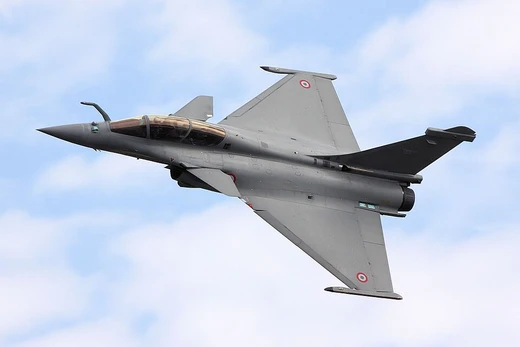
F-14 Tomcat
Variable-sweep wing fighter serving as U.S. Navy's primary interceptor until 2006.

The Grumman F-14 Tomcat is an American carrier-capable supersonic, twin-engine, tandem two-seat, twin-tail, all-weather-capable variable-sweep wing fighter aircraft. Developed for the U.S. Navy's Naval Fighter Experimental (VFX) program after the collapse of the General Dynamics-Grumman F-111B project, it was the first of the American Teen Series fighters designed incorporating air combat experience against smaller, more maneuverable MiG fighters during the Vietnam War. The F-14 served as the U.S. Navy's primary maritime air superiority fighter, fleet defense interceptor, and tactical aerial reconnaissance platform into the 2000s.
- First flight
- 21 December 1970
- Retirement
- 22 September 2006
- Primary operator
- United States Navy
- Export operator
- Imperial Iranian Air Force / Islamic Republic of Iran Air Force
- Role
- Air superiority fighter, fleet defense interceptor, tactical reconnaissance, later precision ground-attack
- Engines
- TF30 (initially), planned replacement with Pratt & Whitney F401-PW-400
Reader's Guide
The F-14 Tomcat's significance lies in its role as the U.S. Navy's primary fleet defense interceptor and air superiority fighter for over three decades, replacing the F-4 Phantom II and later being replaced by the F/A-18E/F Super Hornet. It was the first of the American Teen Series fighters, designed with lessons from Vietnam War air combat against more maneuverable MiG fighters. Its variable-sweep wings allowed it to optimize performance for both high-speed interception and low-speed carrier landings. The F-14's ability to carry the long-range AIM-54 Phoenix missile and the powerful AWG-9 radar made it uniquely capable of defending carrier battle groups against Soviet bombers and anti-ship missiles. The aircraft's export to Iran and subsequent combat use in the Iran–Iraq War demonstrated its effectiveness as a land-based interceptor. The addition of the LANTIRN pod in the 1990s gave the Tomcat a precision ground-attack role, extending its service life. Its retirement in 2006 marked the end of an era for U.S. Navy carrier aviation, with many examples preserved in museums.
Did You Know?
- The F-14 first flew on 21 December 1970, just 22 months after Grumman was awarded the contract.
- The name 'Tomcat' was partially chosen to pay tribute to Vice Admiral Thomas F. Connolly, as the nickname 'Tom's Cat' had been used during development.
- The F-14 was the first of the American Teen Series fighters designed incorporating air combat experience against MiG fighters during the Vietnam War.
Common Misconceptions (Editorial)
A common misconception is that the F-14 was developed entirely from scratch, but it was actually developed after the collapse of the General Dynamics-Grumman F-111B project. Another misconception is that it served primarily as a ground-attack aircraft, when in fact its original and primary roles were air superiority, fleet defense interception, and tactical aerial reconnaissance, with precision ground-attack added later.
Why It Matters (Editorial)
The F-14 Tomcat endures in popular memory not just as a nimble fighter from film and fiction, but as a critical bridge between the flawed F-111B program and the mature Teen Series fighters that defined U.S. naval air power for decades. Its combination of variable-sweep wings, twin-tail stability, and combat lessons from Vietnam produced a uniquely capable fleet defender that outlasted countless rivals, serving from the Cold War through the War on Terror before retiring in 2006.
Frequently Asked Questions
What is F-14 Tomcat's role?
It operated as the Navy's primary maritime air-superiority fighter and long-range fleet-defense interceptor, later expanding into tactical reconnaissance and precision ground-attack missions. Its sweep-wing design let pilots trade speed for maneuverability depending on the engagement.
How does F-14 Tomcat's story end?
The aircraft was formally retired from U.S. Navy service on 22 September 2006, with its last operational carrier sortie flown from USS John C. Stennis. The F/A-18E/F Super Hornet took over as the Navy's frontline carrier fighter from that point forward.
Why is F-14 Tomcat important?
It was the first of the American 'Teen Series' fighters, born directly out of Vietnam War encounters with agile MiG fighters, and it held the Navy's top interceptor slot for 32 years. Its long-range Phoenix missile and sweep-wing combination set a benchmark for carrier-based air dominance.
More in Warplanes 1-22
Spotted an error? Know more?
This is a living reference — every entry is fact-audited, and reader corrections feed straight into our audit queue. Suggest an edit · See this site's audit record