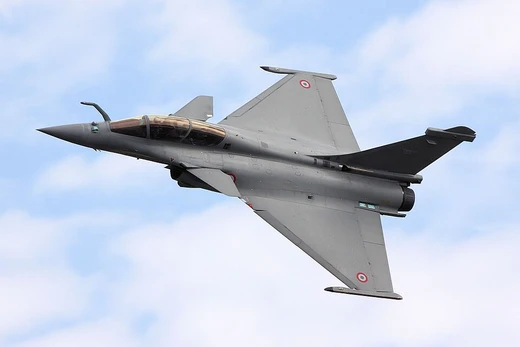
Su-27
Soviet heavy fighter designed to counter US fourth-generation jets.

The Sukhoi Su-27 (NATO reporting name: Flanker) is a Soviet twin-engine supersonic supermaneuverable fighter aircraft designed by Sukhoi. The Su-27 was developed into a family of aircraft including the Su-30, Su-33, Su-34, Su-35, and Su-37, and was license-built in China as the Shenyang J-11.
- Type
- Twin-engine supersonic supermaneuverable fighter
- National origin
- Soviet Union
- Design bureau
- Sukhoi
- Primary role
- Air superiority and long-range air defence
- NATO reporting name
- Flanker
Lore & Background
The specification was split into the lightweight LPFI (resulting in the MiG-29) and the heavy TPFI, assigned to Sukhoi. A major redesign, the T-10S, emerged in 1980 and became the basis for production Su-27s.
Reader's Guide
The Su-27 was designed for long-range air defence against American bombers such as the B-1B and B-52, and for escorting Soviet heavy bombers. Its development involved extensive cooperation with TsAGI and SibNIA, emphasizing supermaneuverability through controlled high angle-of-attack flight. The aircraft set world time-to-height records with the stripped-down P-42 variant. The Su-27 family expanded to include multirole, naval, and strike variants, and its Chinese license-built version, the J-11, extended its global influence. The Su-27's integral aerodynamic scheme and fly-by-wire system influenced later fighter designs.
Did You Know?
- The Su-27 was designed as a complement to the Mikoyan MiG-29.
- The P-42 variant set world time-to-height records after being stripped of armament and radar.
- The Su-27 was license-built in China as the Shenyang J-11.
Common Misconceptions (Editorial)
Some people mistakenly believe the Su-27 was designed as a replacement for the MiG-29, but it was actually developed as a complement to it. Another common misconception is that the Su-27 was entirely a Chinese design; however, it was originally a Soviet design by Sukhoi and only later license-built in China as the Shenyang J-11.
Why It Matters (Editorial)
The Su-27 is more than a single fighter—it is the founding platform of a prolific family of aircraft that continues to serve as the backbone of multiple air forces worldwide. Its combination of range, maneuverability, and adaptability ensures its enduring relevance in modern aerial combat.
Frequently Asked Questions
What is Su-27's primary role?
The Su-27 was built as a long-range air superiority and air-defence fighter, specifically to match large American fourth-generation jets like the F-14 Tomcat and F-15 Eagle.
What aircraft grew out of the Su-27 family?
The Su-27 served as the basis for a wide family of variants, including the Su-30, Su-33, Su-34, Su-35, and Su-37. China also produced a licensed version as the Shenyang J-11.
Why is Su-27 important in aviation history?
It represented the Soviet Union's answer to Western heavy fighters and established the Sukhoi design bureau's reputation for supermaneuverable, twin-engine combat aircraft. Its design philosophy influenced an entire generation of successor jets across multiple countries.
More in Warplanes 1-22
Spotted an error? Know more?
This is a living reference — every entry is fact-audited, and reader corrections feed straight into our audit queue. Suggest an edit · See this site's audit record